

-
Introducing Isolat’s Virtual Data Lake
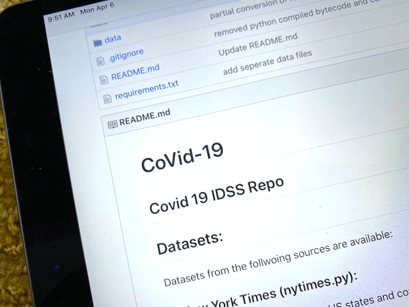
Researchers across the globe have been putting their minds and machines to work addressing many important COVID-19 related questions: When will we run out of hospital beds? How effective are current interventions? How should governments plan for the resumption of work and increased mobility? Timely access to good data is critical for this work. Various groups have made numerous data sources available, and Isolat has gathered some of these sources into a ‘virtual data lake.’ The virtual data lake allows researchers to access a large number of data sources simultaneously, with up-to-date data, using simple python scripts.
READ MORE -
The Impact of Closing Restaurants
Anette "Peko" Hosoi, Associate Dean of Engineering; Neil and Jane Pappalardo Professor, Mechanical Engineering
READ MORE
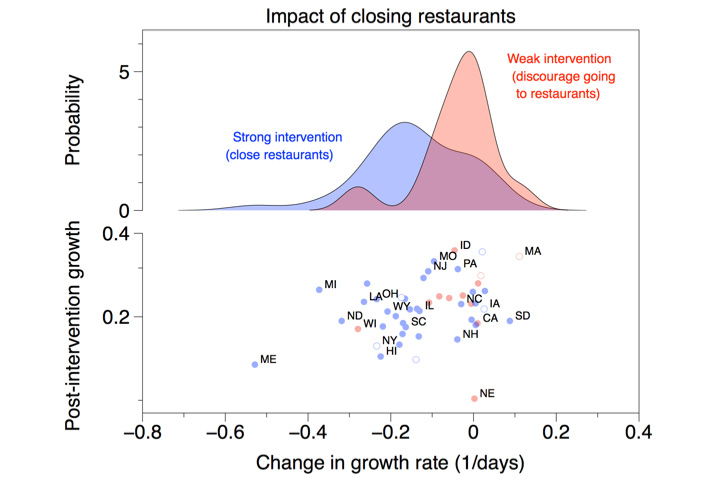
Over the past few weeks, states have taken a variety of different approaches to combat the evolving COVID-19 pandemic. These range from strong actions (e.g. close all bars and restaurants) to relatively mild responses (e.g. discourage people from going to restaurants). This graph shows how much the rate at which the disease spreads, changed in each state after restaurant-related interventions. -

Market Design and Incentive Mechanisms for Efficient Integration of Renewable Energy Resources
Mardavij Roozbehani, Laboratory for Information & Decision Systems
READ MORE
Christopher Knittel, Economics
Roozbehani and Knittel studied the design of electricity markets and incentive mechanisms for the integration of renewable resources. Renewable resources pose challenges to electricity markets, include uncertainty, variability, highly correlated contingencies across large geographical areas, and near zero marginal cost. Roozbehani and Knittel addressed these challenges by developing data driven models and drawing from tools and methodologies in economics, game theory, control theory, and energy networks. -

Informing Sustainability Planning in China and Beyond
Noelle Selin, IDSS and Earth, Atmospheric, and Planetary Sciences
READ MORE
Valerie Karplus, Sloan School of Management
Selin and Karplus integrated economic and environmental modeling and empirical social science techniques to study the effects of energy and climate policies in China. The result of the study was that by meeting its greenhouse gas-reduction goals, China would improve its air quality. This would avoid a significant number of deaths due to air pollution. Fewer deaths from air pollution means a benefit for society that can be quantified as a $339 billion savings in 2030. -

Social Mobility Sharing: Faceless Efficiency or Emerging Mode of Human Interaction
Jinhua Zhao, Urban Studies and Planning
READ MORE
Nigel Wilson, Civil and Environmental Engineering
Zhao and Wilson examined the social aspects of the mobility sharing system. They developed matching algorithms to adhere to both transportation network optimization and the individuals’ preferences, or lack of preferences, for human interactions. The research ultimately provides insights into how policies should be crafted to acknowledge travelers’ preferences while setting boundaries against potential discriminatory behavior. -

Financial Networks and Bank Failures: Sectoral Shocks and Aggregate Fluctuation
Daron Acemoglu, Economics
READ MORE
Munther Dahleh, IDSS and Electrical Engineering and Computer Science
Acemoglu and Dahleh studied the relationship between financial network structures and bank failures. They were interested in better understanding how interbank linkages affect the transmission of adverse shocks in a banking system and how they shape the nature of economic fluctuations. They processed and collected data from a historical dataset of the United States banking system from the 19th century to produce an empirical model that tests whether there is a relationship between a bank's performance and the performance of banks to which it is connected. -

Scalable Probabilistic Inference for the Analysis of International Product Trade Profiles
Tamara Broderick, Electrical Engineering and Computer Science and Computer Science and Artificial Intelligence Laboratory (CSAIL)
READ MORE
In Song Kim, Political Science
The central goal of this project was to identify hidden economic and societal forces in international trade by developing scalable machine learning algorithms for the probabilistic inference of massive amounts of trade data. Probabilistic inference can establish the complex models required for these analyses, but in practice is often slow to run. Broderick and Kim used computational-statistical trade-offs to obtain the necessary run-time gains to make these analyses more practical. -

Repurposing Drugs for Alzheimer’s Disease using Electronic Health Records and Modern Data Analytics
Stan Finkelstein, IDSS
READ MORE
Roy Welsch, Sloan School of Management
Researchers studied the repurposing of FDA-approved drugs in order to identify new uses of medicines. The goal of this ongoing work is to use observational medical and health data, including harnessing large Electronic Health Record (EHR) datasets using modern data analytic methods and tools, to look for clinical signals that drugs currently prescribed for one condition could be beneficial to patients suffering from another condition. This research could speed up drug development and reduce costs and risks in the future. -

Predicting the Popularity of Online Jihadist Writing
Rich Nielsen, Political Science
READ MORE
Ali Jadbabaie, IDSS and Civil and Environmental Engineering
Nielsen and Jadbabaie analyzed data on jihadist extremist documents to build a model that would shed light on why some documents are more popular than others, and predict which new statements by jihadists are most likely to go viral. They used data from a large jihadist web library to build a model that predicts the number of page views based on features in each document. -

Security of Global Undersea Networks: Models, Defenses, and Policy Mechanisms
Saurabh Amin, Civil and Environmental Engineering
READ MORE
Nazli Choucri, Political Science
Amin and Choucri's research focused on the security and survivability of a critical global infrastructure: submarine fiber optic networks. Undersea networks are highly structured and widely distributed systems that play a critical role in the transmission of global communications. The goal of this project is to create robust foundations for an integrated technology-policy approach to examine the cyber-physical security and sustainability of critical global infrastructures.
Institute for Data, Systems, and Society (IDSS) is committed to addressing complex societal challenges by advancing education and research at the intersection of statistics, data science, information and decision systems, and social sciences.
News

IDSS staging site resynchronized with live site
The IDSS staging site was updated from the live IDSS site on February 10, 2020.

A college for the computing age
IDSS will continue to address complex societal challenges and support statistics across MIT as we join the Schwarzman College of Computing.

Guy Bresler Receives NSF CAREER Award
IDSS and LIDS faculty member Guy Bresler has received an NSF CAREER Award for his research on “Reducibility among high-dimensional statistics problems: information preserving mappings, algorithms, and complexity.”